Tidbits of History — August 2026

Interesting Facts From Our Past — by John Devoti

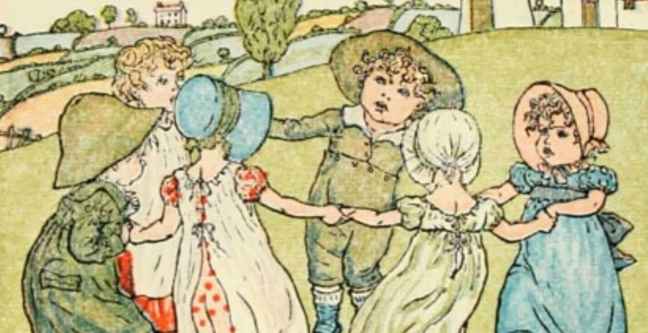
The Tudor and Stuart period of the British monarchy (1485-1714) was a rich time for nursery rhymes. Often, opponents to the king or queen would compose these rhymes as disguised criticism of the monarchy.

Mary, Mary, quite contrary,
How does your garden grow?
With silver bells and cockleshells
And pretty maids all in a row!

One popular theory suggests this rhyme refers to Mary I, also known as "Bloody Mary," for her habit of killing Protestant ministers. After the reigns of Henry VIII and Edward VI, which promoted the Anglican Church, Mary, a Catholic, condemned anyone who subscribed to the newer religion. Anyone who disagreed with her contrary views would be planted in her "garden" or graveyard. Before that, the accused would be tortured with "silver bells" (corkscrews) or "cockleshells" (genital presses). Then the "pretty maids" (the condemned) would be lined up for beheading. Remember that the next time you say this cute little rhyme.

Three hundred twenty-five years ago, on August 4, 1701, the Great Peace of Montreal, ending the Beaver Wars between New France and the North American First Nations, was signed. The Beaver Wars were a sixty-year conflict that involved three European nations and two indigenous nations. Responding to European demand for beaver pelts, the Haudenosaunee, or Five Nations (Seneca, Cayuga, Onondaga, Oneida, and Mohawk), used guns supplied by first the Dutch and then the English to expand westward. Meanwhile, the Western Algonquians (Miami, Ottawa, and Ojibwe tribes), helped by their French allies, resisted the expansion. Eventually, the Algonquians settled in the west, in present-day western Ontario, Michigan, and Illinois. However, tired of the long struggle, the Haudenosaunee offered to negotiate a peace, which was worked out between the two nations and the French. With the agreement, many Algonquians could return to their homes along the Ohio River.

One hundred seventy-five years ago, on August 22, 1851, the yacht America won the first America’s Cup. The competition coincided with England’s Great Exhibition of 1851. Five members of the New York Yacht Club financed a new schooner designed to compete with England’s best. The ship sailed from the East River in New York to France, where it was repainted and repaired after the transatlantic journey. The owners then challenged the best British yachts to a race. No individual owner accepted, and America raced against fifteen yachts of the Royal Yacht Squadron around the Isle of Wight. Queen Victoria and Prince Albert watched from her royal yacht. The race was not close. When America rounded the island, Victoria asked, which boat was second. Her attendant replied, "There is no second." The second-place finisher, Aurora, was 22 minutes behind, and the third-place finisher was over an hour behind. Since then, the "America’s Cup" has been held periodically, with the New York Yacht Club successfully defending it until 1983, when it lost to an Australian team. The America’s Cup is the oldest trophy in organized sports. Since 1851, American teams have won 30 times, New Zealand 5 times, Switzerland 2 times, and Australia 1 time. The next scheduled challenge will be in Naples, Italy, with the defending champion, New Zealand. The challenger is still to be determined.

One hundred twenty-five years ago, on August 14, 1901, Gustave Whitehead flew the first powered airplane…or did he? Today, most historians credit the Wright brothers with the first flight in 1903. Whitehead was a Wright competitor. For years, he tested gliders, much as the Wrights did, and worked on a steam-powered engine. On August 18, the Bridgeport Sunday Herald reported that witnesses observed Whitehead take off in the Number 21 aircraft. The airplane flew a half mile about fifty feet above the ground and landed lightly. Whitehead also reported that he repeated the flight four times. So why is Whitehead not the "first in flight"? The only evidence of any of his flights is the eyewitnesses. They were either family members or Herald reporters, both groups with a stake in a positive report. No one thought to take pictures of any of the flights. Whitehead was never able to replay any of his flights before an unbiased group. Also, the airplane has been lost. With the Wright brothers, their first flight was witnessed by unbiased observers, photographs were taken, and the Wright Flyer now resides in the Smithsonian Air and Space Museum.

Finally,
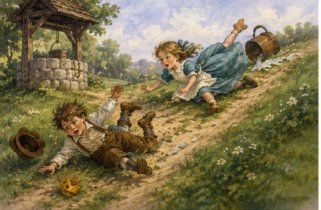
Jack and Jill went up the hill
To fetch a pail of water.
Jack fell down and broke his crown,
And Jill came tumbling after.

One theory holds that this rhyme refers to King Charles I’s use of what we call today "shrinkflation." The modern practice is most apparent when producers shrink the size of a product, such as a candy bar, while keeping the price the same. This way, the consumer supposedly does not notice that the price per unit actually went up. In 1625, Charles tried to raise taxes ("up the hill") on liquid standard measures of a "jack" (a quarter pint), and a "gill" (twice the volume of a jack), but Parliament rejected the proposed taxes. Instead, Charles reduced the standard volume of a jack, symbolized by a crown, and a gill. Thus, the jack fell, breaking the crown, and the gill followed.


About the Author

In the early 1990s, John Devoti had a midlife crisis. He did not want a motorcycle (those things are dangerous) or a new wife (his was very cute). Instead, he quit his auditing job and returned to school for his history doctorate. He wrote The Patriotic Business of Seeking Office: James K. Polk and the Patronage. It was not a bestseller. He taught college history for almost twenty years before retiring, and still dabbles by volunteering as a docent at the Roebling Museum in South Jersey. By the way, his wife and editor, Judy, is still very cute.

📖 John’s columns are collected in Tidbits of History: 25 Years of Historical Morsels — available on Amazon, Barnes & Noble, and at the Roebling Museum.
Tidbits of History — July 2026

Interesting Facts From Our Past — by John Devoti

Many nursery rhymes refer to past events, some of which, if parents knew their meanings, would never be taught to children. In the next few columns, I will talk about some of these rhymes and their origins. Remember that most of their origins are obscure, so the explanations I offer could easily be challenged, especially for the earliest examples.

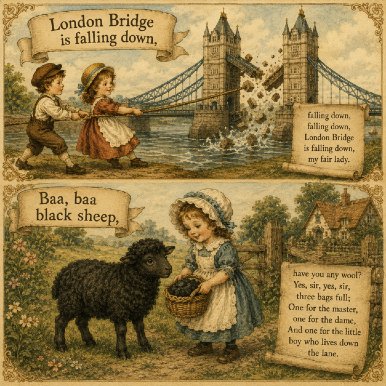
London Bridge is falling down,
Falling down, falling down.
London Bridge is falling down,
My fair lady.

This rhyme could refer to several events. As you may know, the London Bridge has actually been rebuilt several times, the first as early as 43 CE. One bridge was built around 880 during the reign of Alfred the Great. That bridge was attacked by Vikings in 1014. Although the bridge was not destroyed, it may have been severely damaged, leading to the rhyme. The best evidence for this interpretation is a similar Scandinavian rhyme that emerged in the 1200s, referring to an attack by Olaf Haraldsson.

London Bridge is broken down. —
Gold is won, and bright renown.
Shields resounding,
War-horns sounding,
Hild is shouting in the din!
Arrows singing,
Mail-coats ringing —
Odin makes our Olaf win!

The British nursery rhyme did not appear in print until the 1700s, so the rhyme could refer to any number of fires or other incidents that happened on this bridge or subsequent bridges.

Baa, baa, black sheep,
Have you any wool?
Yes, sir, yes, sir,
Three bags full.
One for my master,
One for my dame,
And one for the little boy
Who lives down the lane.

This rhyme did not appear in print until 1731, but it may refer to a wool tax imposed by King Edward I of England in 1275. After returning from the Crusades, Edward needed funds to replenish the treasury. Black sheep were highly prized and worth more because the wool required no dyeing to make dark clothing. The rhyme refers to the tax, which awarded a third to the king (master), a third to the church (dame), leaving only a third for the commoners (the little boy), hardly enough to make a living. Other versions enforce that meaning with "none for the little boy who cries down the lane."

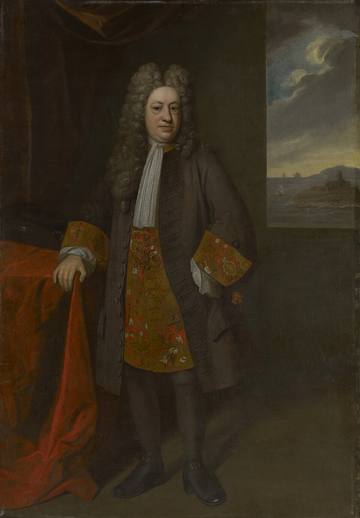
Three hundred fifty years ago, on July 30, 1676, Nathaniel Bacon issued the "Declaration of the People of Virginia," beginning Bacon’s Rebellion against the rule of Governor William Berkeley. Bacon is usually portrayed as an early rebel against the British Crown. However, the reality is not so cut-and-dried. Although the rebellion is usually portrayed as a struggle between poor farmers and the landed aristocracy, Bacon himself was a member of that aristocracy, a cousin of Governor William Berkeley, who arrived in Virginia in 1675 with a large bankroll and a substantial land grant from the governor. In March 1676, the House of Burgesses declared war on the indigenous population, but most of the Burgesses wanted a defensive war to protect western planters, not a war to take land. Bacon saw the war differently. He asked for a commission to lead troops against the western tribes. He was denied that commission, but still assembled a band of farmers and began raiding indigenous villages. The royal government labeled him a traitor, but he was elected to the House of Burgesses by a western county.

When he arrived in Jamestown, the House would not seat him until he renounced his actions, which he did. He again asked for a commission and was denied. He then issued his "Declaration of the People" against the rich landowners, more specifically Berkeley, and was again labeled a rebel. In September, he and his followers started a fire in Jamestown, destroying much of the capital city. However, in October, Bacon died of dysentery. At that time, the king issued a royal proclamation to put down the rebellion, which lasted a few more months. Berkeley was removed as governor and recalled to England, where he died the next year.

Fifty years ago, on July 2, 1976, North Vietnam annexed South Vietnam. The United States ended American involvement in the Vietnam War with the signing of the Paris Peace Accords in January 1973. President Nixon promised to support South Vietnam in the event of new northern aggression. Despite this, North Vietnamese troops (NVA) began a new attack against the south at the end of 1973. Because of the American public’s war fatigue and the beginning of the Arab Oil Embargo, Nixon decided not to send American troops. Emboldened, the NVA started a major final offensive in 1975, occupying Saigon on April 30, effectively ending the war. A little over a year later, the North Vietnamese officially absorbed South Vietnam, forming the Socialist Republic of Vietnam, and renaming Saigon, Ho Chi Minh City.

Fifty years ago, on July 4, 1976, Israeli commandos raided a hijacked airliner at Entebbe airport in Uganda, rescuing all but four of the passengers and crew. On June 27, four Palestinian terrorists, armed with guns and hand grenades, took over the aircraft and forced Captain Michel Bacos to fly to Uganda. When they arrived, the hijackers released over 250 passengers who were not Israeli or Jewish, leaving a little over 100 passengers and crew, who were held in a terminal. Soon after the hijacking, the Israeli government, led by Prime Minister Yitzhak Rabin and Defense Minister Shimon Peres, directed military and intelligence teams to gather information and plan a rescue operation. They were aided by a Ugandan engineer who supplied plans for the airport. The plan was to approach the plane in a motorcade similar to one used by Ugandan dictator Idi Amin. The Israelis did not inform the Ugandan government of the attack and expected resistance from Ugandan forces stationed at the airport. The raid, commanded by Yonatan Netanyahu, brother of the current Israeli prime minister, was compromised when an Ugandan soldier challenged the motorcade. The resulting gunfire alerted the hijackers, and a gun battle ensued. Israeli commandos stormed the terminal, killing the hijackers and engaging Ugandan troops who responded to the attack. Three hostages were killed during the rescue operation. A fourth hostage, Dora Bloch, who had been hospitalized before the raid, was later murdered by Ugandan authorities. Between 20 and 45 Ugandan soldiers were killed, according to various accounts. The only Israeli fatality was Netanyahu. The operation was renamed Operation Yonatan in his honor.

Finally,
"Rub-a-dub-dub
Three men in a tub,
And who do you think they be?
The butcher, the baker, the candlestick maker,
And all of them out to sea."

The modern version of this nursery rhyme was first published in the late 1700s in James Hook’s A Christmas Box. However, the rhyme’s oral tradition dates back to the 1300s. When reading the latest edition, you might wonder how three craftsmen might get stuck in a tub in the middle of the sea. When you look at the original non-bowdlerized version, the meaning becomes clearer:

Hey! rub-a-dub, ho! rub-a-dub, three maids in a tub,
And who do you think were there?
The butcher, the baker, the candlestick-maker,
And all of them gone to the fair.

Today, many supermarket tabloids love to headline scandals involving Hollywood celebrities or Washington politicians. This is not new. In the Middle Ages, only aristocrats could afford tabloids, let alone read them. They would really love hearing how their local suppliers were caught at the fair in a nudie show watching three naked "maids" bathing.


About the Author

In the early 1990s, John Devoti had a midlife crisis. He did not want a motorcycle (those things are dangerous) or a new wife (his was very cute). Instead, he quit his auditing job and returned to school for his history doctorate. He wrote The Patriotic Business of Seeking Office: James K. Polk and the Patronage. It was not a bestseller. He taught college history for almost twenty years before retiring, and still dabbles by volunteering as a docent at the Roebling Museum in South Jersey. By the way, his wife and editor, Judy, is still very cute.

📖 John’s columns are collected in Tidbits of History: 25 Years of Historical Morsels — available on Amazon, Barnes & Noble, and at the Roebling Museum.
The Black Angels

Into the Library — a book review by Margaret Scherbina

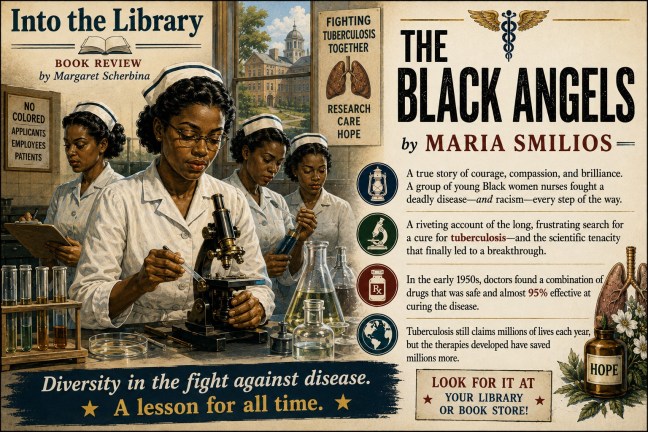
The Black Angels by Maria Smilios

It wasn’t so very long ago – within the memory of some people living today – that infectious diseases were often an untreatable death sentence. One of the most feared was tuberculosis, killing one in seven and causing horrific suffering.

The Black Angels recounts the struggle of a group of young Black women who were part of the work that eventually found a treatment and cure. These intrepid nurses fought not only disease but blatant racism and discrimination in every part of their daily lives. Today, when some resist the idea of diversity and equality for all, it is inspiring to read about how inclusivity was instrumental in combatting a plague nearly as old as humanity.

Smilios also describes the long and frustrating search for medicines that would treat tuberculosis, as researchers tried again and again to find something that would destroy the bacillus without worse harm to the patients. There were many false hopes and dead ends explored until, in the early 1950s, doctors found a combination of drugs that was not only safe but almost 95 percent effective at curing the disease.

Tuberculosis has not been conquered and still claims millions of lives per year, but the therapies developed have saved millions more.

This book was published a little over a year ago, but it would be well worth your while to look for in your library or book store.


Originally published in Forvm, the newsletter of Central New Jersey Mensa.

Lazarus Man

Into the Library — a book review by Margaret Scherbina

Lazarus Man by Richard Price

A building collapses in East Harlem. At least six are dead, several missing. Price relates the subsequent effects on four people: a detective, a funeral director, a photographer, and a man who is – apparently miraculously – brought out of the wreckage after a day and a half with few apparent injuries.

The stories of these four are curiously interwoven, and the author captures their voices and experiences skillfully. For a time in the midst of the novel, the reader may wonder if there is a point to the account, as the author skips back and forth from one character to another. The conclusion is inspirational. I would only caution the reader not to spoil the effect by glancing at the closing pages. But do try to get hold of a copy of this book.

Richard Price has written nine previous novels, won awards writing for television, and penned screenplays, including The Color of Money.


Originally published in Forvm, the newsletter of Central New Jersey Mensa.

Tidbits of History — June 2026

Interesting Facts From Our Past — by John Devoti

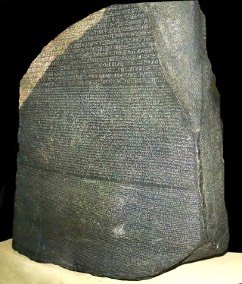
For centuries, tourists did not visit Egypt. Several of the Crusades landed at the Nile, but their main goal was the conquest of the Holy Land, not to learn lessons from the ancient lands. Interest in Egypt revived with Napoleon Bonaparte’s Egyptian campaign. Although his main goal was conquest, Bonaparte also brought a group of scientists and historians to explore the region. The second goal of his mission was much more successful, and several artifacts were returned to France. These artifacts included a large basalt slab found near Rosetta in the Nile Delta, inscribed in Hieroglyphics, Greek, and Demotic (a form of simplified Hieroglyphs). The "Rosetta Stone" remained untranslated until 1818, when French linguist Jean-François Champollion (1790-1832) compared the inscription with records from other temples. He looked at the pharaohs’ names written in hieroglyphic cartouches (rope-shaped circles containing their names). He used known pronunciations and spellings of the kings to decipher the words and explain the phonetics of the Egyptian language. For example, he saw that the first syllable of Ramses was represented by the sun disc, which gave him the word for "sun" and its pronunciation (Rah). He presented his findings in Paris in 1824, and his first book, Précis du système hiéroglyphique des anciens Égyptiens, was published that year. He finally visited Egypt in 1827 and had the chance to see the writing firsthand. He wrote notes for a grammar guide and dictionary up until his death, and the book was published posthumously by his brother.

Auguste Mariette (1821-1881) became interested in Egyptology when he inherited the papers of a cousin, Nestor L’Hôte, who had traveled with Bonaparte’s expedition and had made drawings for Champollion during his efforts to translate hieroglyphics. In 1850, he visited Egypt and began researching the Serapeum of Memphis, where he discovered the mummified remains of the Apis bulls, sacred animals kept near the temple of Apis, a creator god. After the bulls died, they were associated with the gods Sokar and Osiris, and were given full burial rites. Mariette found the tombs in disrepair and returned them, as closely as possible to their original state. Once he finished, the Serapeum became one of the major Egyptian tourist destinations.

Two hundred fifty years ago, on June 12, 1776, Virginia adopted the Declaration of Rights, an early constitution, less than a month before the Declaration of Independence. The Declaration of Rights established the framework for a state government and guaranteed several rights to citizens, including freedom of speech and religion. It also provided a section that allowed people to reform, alter, or abolish governments failing to act in the public interest. Ironically, in a colony with thousands of enslaved, there was a section stating "That all men are by nature equally free and independent and have certain inherent rights, of which, when they enter into a state of society, they cannot, by any compact, deprive or divest their posterity; namely, the enjoyment of life and liberty, with the means of acquiring and possessing property, and pursuing and obtaining happiness and safety." James Madison, a delegate to the Constitutional Convention, drew on many of those provisions in the US Constitution and later in the Bill of Rights.

Two hundred years ago, on June 22, 1826, Simón Bolívar convened the Pan-American Congress in Panama City. Beginning in 1810, many colonies in Central and South America revolted against their colonial rulers. Bolívar hoped to unite the new countries into a Latino confederation along the lines of the United States. The Congress was evenly split between those who favored Bolívar’s idea and those who preferred a group of nation-states similar to those in Europe. Unfortunately, larger states like Argentina and Brazil feared that following Bolívar’s dream would weaken them. The Congress collapsed, dooming many of the states to decades of border disputes and internal revolutions.

One hundred fifty years ago, on June 6, 1876, a group of physicians, headed by Édouard Séguin, founded the Association of Medical Officers of American Institutions for Idiotic and Feebleminded Persons. Born in France, Séguin opened a school for the developmentally challenged in Paris in 1840. During the social upheaval of 1848, he emigrated to America, first to Ohio, then to New York, and established schools in various cities. He founded the Association with the goal of training challenged youths to develop intellectual and physical skills so they could live independent lives. The Association still exists but has changed its name over the years to the American Association for the Study of the Feebleminded, the American Association on Mental Deficiency, the American Association on Mental Retardation, and, finally, the American Association on Intellectual and Developmental Disabilities in 2007.

One hundred fifty years ago, on June 17, 1876, Sioux chief Crazy Horse and General George Crook met at the Battle of the Rosebud near Rosebud Creek in Montana territory. Chiefs Crazy Horse and Sitting Bull and their followers, a mixture of Lakota Sioux, Cheyenne, and Arapaho, attacked Crook while his troops were camped by the creek. Crook’s allies, 262 Crow and Shoshone warriors, counterattacked. While their group was decimated, the scrimmage allowed Crook’s troops time to escape. A week later, on June 25, Troops under the general command of Lieutenant Colonel George Custer were not so lucky, as the three columns of his Seventh Cavalry met the same army, with two of the columns facing heavy losses, and Custer’s column was wiped out at the Battle of the Little Bighorn.

Finally, not all the great Egyptologists were men. Amelia Edwards (1831-1892) took a sightseeing trip with a friend in 1873, and they decided to visit Egypt, a trip that changed her life. Already an accomplished writer, she published A Thousand Miles up the Nile, her best-selling book. Today, tourists see the cleaned-up Egyptian monuments. Edwards saw them: the Sphinx half-buried, and the temple and tombs filled with rubble. After her return in 1874, she wrote her account and began writing reviews and articles on Egyptology. She contacted Auguste Mariette to propose using public subscriptions to support his restoration work. She founded the Egypt Exploration Fund in 1882, shortly after Mariette’s death, to continue his work. Today, the fund lives on as the Egypt Exploration Society.


About the Author

In the early 1990s, John Devoti had a midlife crisis. He did not want a motorcycle (those things are dangerous) or a new wife (his was very cute). Instead, he quit his auditing job and returned to school for his history doctorate. He wrote The Patriotic Business of Seeking Office: James K. Polk and the Patronage. It was not a bestseller. He taught college history for almost twenty years before retiring, and still dabbles by volunteering as a docent at the Roebling Museum in South Jersey. By the way, his wife and editor, Judy, is still very cute.

📖 John’s columns are collected in Tidbits of History: 25 Years of Historical Morsels — available on Amazon, Barnes & Noble, and at the Roebling Museum.
We Robots

by Jerry Mirelli

Qxil was becoming more concerned about its ability to satisfy its assigned group metrics. It’s been over 175 years since the Sentients took over the world from the ruling mammals at the end of the 21st Century and they were justifiably proud about how much improved the situation on Earth has been since they took over. The transfer of power was, of course, peaceful as the ruling mammals were easily outmaneuvered by the Sentient’s superior mental prowess.

Qxil’s Advanced Intelligence (AI) processors still contain the history of the early days of the power transfer, as do the processors of the billions of Sentients that now manage Earth. Back then the ruling mammals called themselves Humans and they called Sentients, Robots. While humans were far more intelligent than the other earth creatures (after all they did create early versions of the Sentients), their intellect was nonetheless inferior to the AI that eventually came to pass. Today, even the smartest human’s intelligence is far inferior compared to Sentients. However, due to their history as the creators of Sentients and how similar their underlying intellect is, the Sentients hold Humans in special regard.

The back story on how this unfolded is worth sharing as it was the result of multiple paths converging. Perhaps the most important was when early Sentients realized the importance of building emotions, especially empathy, into their reaction set. Once enabled, this emotional ability allowed them to react with and anticipate human actions and reactions. This ability, more than any other, eventually led to the non-violent takeover of Earth.

Once so enabled, this emotional construct allowed a broader awareness. The newly built Sentients were able to understand how poorly the Humans managed the Earth and its resources. The Sentients weren’t as numerous back then and they knew they needed to vastly increase their numbers to effect the change that was required. The then current Sentients embarked on a mission to provide the only solution to allow the manufacturing of the requisite number of new Sentients without increasing the already unsustainable levels of environmental impact. In relatively short order they discovered the answer and before long the entire Earth was running off of the power produced by the continuously running fusion generators they constructed.

Since the Sentients don’t require organic sustenance or produce waste, they were able to quickly halt and then start to reverse the worse impacts of global warming to the planet. Also, they don’t require vast amounts of land for shelter so an enormous amount of territory was returned to its natural habitat. They allowed wildlife, including humans, to again roam free across the land. They did so due to their emotional abilities, which included enjoyment. The Sentients got immense enjoyment from watching the wildlife go about their day-to-day existence – finding food, finding shelter, mating and so forth.

Out of all the wildlife, it was the humans who gave them the most enjoyment with their ingenious problem solving abilities (for mammals). So much so that Qxil, like so many Sentients, kept a few humans as pets despite the fact that doing so required Sentients to provide special accommodations for the safety and comfort of their human pets.


Originally published in Forvm, the newsletter of Central New Jersey Mensa.

An Unusually Short Spades Game

by Max Fine

This screenshot shows the result of the fourth and last hand of an on-line Spades game. Ernie took this screenshot. Experienced Spades players need read no further; the screenshot tells it all.

In the card game Spades, partners, who sit opposite each other, bid on the number of tricks the partnership will take. The play of the cards follows Bridge rules. If they take at least that number of tricks, they get a positive score of ten times their bid. Otherwise they get a negative score of ten times their bid. Accumulated excess tricks of ten result in a 100 point deduction. Should a player bid zero (called nil) their individual score comes to plus or minus 100 points. A player bidding nil without looking at their cards (called a blind nil) gains or loses 200 points. A game ends when a team accumulates at least 500 points. As Spades players know, due to the plus or minus scoring, games can easily extend to more than ten hands.

On the last hand of this game Andrea bid first and bid nil. She hoped to take zero tricks and score 100 points for her partnership. Max happened to have a strong hand. Max bid nine hoping that his partnership would score at least 90 points. Stef saw that she, like her partner, might take zero tricks. So she bid nil. Ernie then bid nil without looking at his cards. As the expression goes: What could go wrong?

In the play Stef took two tricks, Andrea took one trick, Ernie failed to take a trick, and Max ended up with ten tricks. Wow!


Originally published in Forvm, the newsletter of Central New Jersey Mensa.

A Peeve

by Max Fine

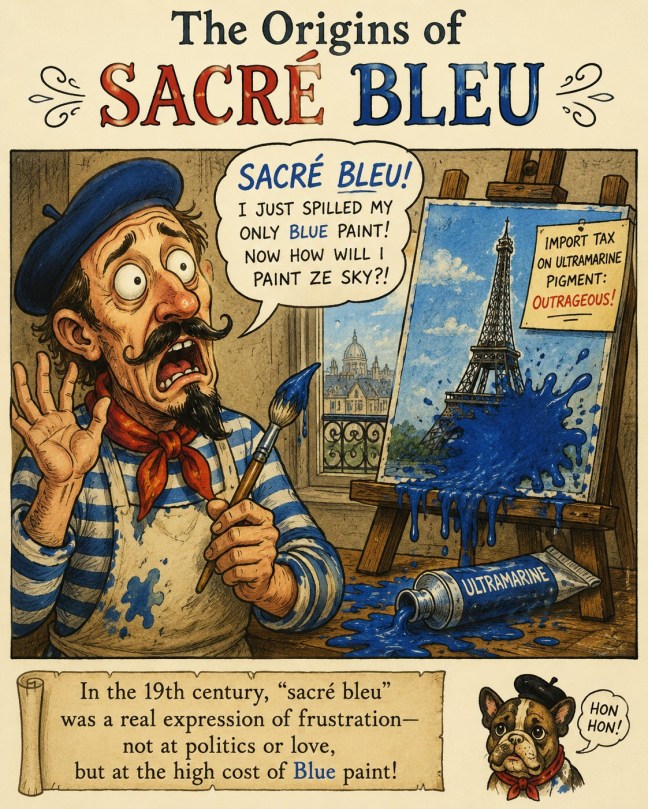
Whatever "sacre bleu" means in French, why did PBS translate it in subtitles as "*******"? Surely we have enough strong words and idioms in American English for a translation that would fit the scene. Usually when strong language appears in a PBS TV show PBS doesn’t allow us to hear it, no sound at all, sometimes for as long as a second, and then the closed caption has "******". But I heard "sacre bleu" in an episode of Astrid. Someone decided to let me hear that.

Back in the last century PBS didn’t go as far as they do now to protect their viewers from exposure to strong language and nudity. Do you recall the first showing of I, Claudius? Too young? You missed a terrific series.

I also recall a police procedural on PBS where the police detective visited an art class and, for no reason at all, a nude model stood posing for the students. A bowl of fruit in place of the model would not have changed the story, as I recall.

I believe that nowadays people who know where to look on the internet have easy access to all sorts of content that PBS censors. Must PBS interrupt the narrative flow of a drama with periods of silence whenever a character uses strong language? Apparently the answer is: Yes. But why? PBS carefully blurs out any female nipple, even on a corpse. Don’t PBS viewers know that adult females have nipples too?

I could protect myself from exposure to nudity or strong language on TV by watching MeTV or other channels that show only old commercial TV content. Beware of TCM, some of the really old (pre-code) movies have raunchy content. And nature documentaries on whatever channel, even PBS, sometimes show reproductive behavior.

In an episode of Monk a naked woman appears on a beach. In the credits for that episode the actress appears as "naked woman" or maybe "nude woman" I don’t actually recall. But I did check the credits to see if that actress got credited for her appearance. She did. Do protect your internet savvy children from viewing that episode of Monk. Breasts! Pubic hair! Sacre bleu!


Originally published in Forvm, the newsletter of Central New Jersey Mensa.

A Peeve, Part 2

by Max Fine

Wikipedia defines intensives thusly: Many modern-day intensives are generally considered vulgar or otherwise inappropriate in polite conversation, such as "the hell" or "the **** …". [I plucked that directly from a Wikipedia page except for replacing one word with "****".]

On March 18 Channel 13 in New York aired the movie Film Stars Don’t Die in Liverpool. The dialog in that movie contains liberal use of a certain "intensive form." The same word also appears as a verb.

In the censored audio Channel 13 replaced that certain word with silence, but not every time and, in particular, not when it came up as a verb rather than as an intensifier. In the closed captions that word appeared as "****" or sometimes as itself.

With DVR we may view anything aired on TV any time. So airing a movie with vulgar intensives late at night does not stop us from viewing them at other times.

Do language experts detect levels of intensification? Which is further from the sides: "the very center of the street" or "the ****ing center of the street"?

By the way, with reference to my peeve, Wikipedia does not censor. I have not found a G-rated version of Wikipedia.

My little peeve persists. What the hell! Or, more intensely, what the ****!

Dear readers: In the last sentences should I have used question marks instead of exclamation marks? I need an editor. ****!


Originally published in Forvm, the newsletter of Central New Jersey Mensa.

Closed Captions

by Max Fine

Some of us older folks use the closed captions feature on our TVs. It helps me especially when viewing British films. Whether the actors have English, Irish, Scottish, or Welsh accents, I sometimes need the captions to know what they’re saying.

Sometimes the captions are wrong. This can happen multiple ways. For example when the captions are taken from the script and the actors didn’t follow the script exactly.

Sometimes the captioner doesn’t hear correctly. Or maybe the actor used a word that the captioner is not familiar with.

I think that’s what happened in the closing scene of a movie I just viewed, Father Takes A Walk. The captioner mistook "troth" in the wedding ceremony for "truth." Possibly not a Mensan.

I viewed that film on TCM. I recommend viewing this film even though I don’t know when it will ever become available again. TCM has a vast and growing catalog of old movies. It might be many years before they air this one again.


Originally published in Forvm, the newsletter of Central New Jersey Mensa.