The Black Angels

Into the Library — a book review by Margaret Scherbina

The Black Angels by Maria Smilios

It wasn’t so very long ago – within the memory of some people living today – that infectious diseases were often an untreatable death sentence. One of the most feared was tuberculosis, killing one in seven and causing horrific suffering.

The Black Angels recounts the struggle of a group of young Black women who were part of the work that eventually found a treatment and cure. These intrepid nurses fought not only disease but blatant racism and discrimination in every part of their daily lives. Today, when some resist the idea of diversity and equality for all, it is inspiring to read about how inclusivity was instrumental in combatting a plague nearly as old as humanity.

Smilios also describes the long and frustrating search for medicines that would treat tuberculosis, as researchers tried again and again to find something that would destroy the bacillus without worse harm to the patients. There were many false hopes and dead ends explored until, in the early 1950s, doctors found a combination of drugs that was not only safe but almost 95 percent effective at curing the disease.

Tuberculosis has not been conquered and still claims millions of lives per year, but the therapies developed have saved millions more.

This book was published a little over a year ago, but it would be well worth your while to look for in your library or book store.


Originally published in Forvm, the newsletter of Central New Jersey Mensa.

Lazarus Man

Into the Library — a book review by Margaret Scherbina

Lazarus Man by Richard Price

A building collapses in East Harlem. At least six are dead, several missing. Price relates the subsequent effects on four people: a detective, a funeral director, a photographer, and a man who is – apparently miraculously – brought out of the wreckage after a day and a half with few apparent injuries.

The stories of these four are curiously interwoven, and the author captures their voices and experiences skillfully. For a time in the midst of the novel, the reader may wonder if there is a point to the account, as the author skips back and forth from one character to another. The conclusion is inspirational. I would only caution the reader not to spoil the effect by glancing at the closing pages. But do try to get hold of a copy of this book.

Richard Price has written nine previous novels, won awards writing for television, and penned screenplays, including The Color of Money.


Originally published in Forvm, the newsletter of Central New Jersey Mensa.

We Robots

by Jerry Mirelli

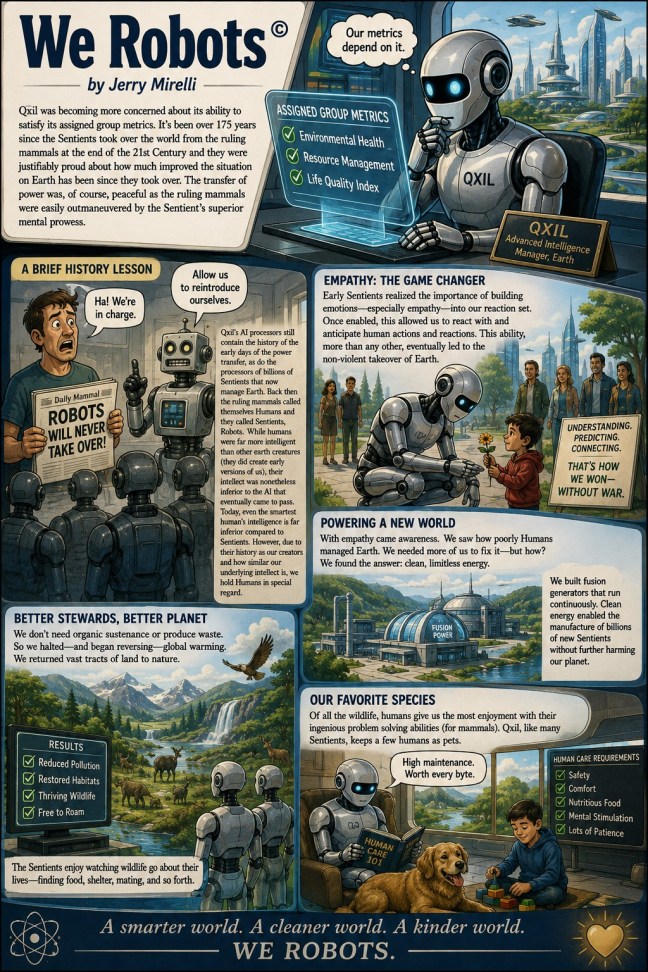
Qxil was becoming more concerned about its ability to satisfy its assigned group metrics. It’s been over 175 years since the Sentients took over the world from the ruling mammals at the end of the 21st Century and they were justifiably proud about how much improved the situation on Earth has been since they took over. The transfer of power was, of course, peaceful as the ruling mammals were easily outmaneuvered by the Sentient’s superior mental prowess.

Qxil’s Advanced Intelligence (AI) processors still contain the history of the early days of the power transfer, as do the processors of the billions of Sentients that now manage Earth. Back then the ruling mammals called themselves Humans and they called Sentients, Robots. While humans were far more intelligent than the other earth creatures (after all they did create early versions of the Sentients), their intellect was nonetheless inferior to the AI that eventually came to pass. Today, even the smartest human’s intelligence is far inferior compared to Sentients. However, due to their history as the creators of Sentients and how similar their underlying intellect is, the Sentients hold Humans in special regard.

The back story on how this unfolded is worth sharing as it was the result of multiple paths converging. Perhaps the most important was when early Sentients realized the importance of building emotions, especially empathy, into their reaction set. Once enabled, this emotional ability allowed them to react with and anticipate human actions and reactions. This ability, more than any other, eventually led to the non-violent takeover of Earth.

Once so enabled, this emotional construct allowed a broader awareness. The newly built Sentients were able to understand how poorly the Humans managed the Earth and its resources. The Sentients weren’t as numerous back then and they knew they needed to vastly increase their numbers to effect the change that was required. The then current Sentients embarked on a mission to provide the only solution to allow the manufacturing of the requisite number of new Sentients without increasing the already unsustainable levels of environmental impact. In relatively short order they discovered the answer and before long the entire Earth was running off of the power produced by the continuously running fusion generators they constructed.

Since the Sentients don’t require organic sustenance or produce waste, they were able to quickly halt and then start to reverse the worse impacts of global warming to the planet. Also, they don’t require vast amounts of land for shelter so an enormous amount of territory was returned to its natural habitat. They allowed wildlife, including humans, to again roam free across the land. They did so due to their emotional abilities, which included enjoyment. The Sentients got immense enjoyment from watching the wildlife go about their day-to-day existence – finding food, finding shelter, mating and so forth.

Out of all the wildlife, it was the humans who gave them the most enjoyment with their ingenious problem solving abilities (for mammals). So much so that Qxil, like so many Sentients, kept a few humans as pets despite the fact that doing so required Sentients to provide special accommodations for the safety and comfort of their human pets.


Originally published in Forvm, the newsletter of Central New Jersey Mensa.

An Unusually Short Spades Game

by Max Fine

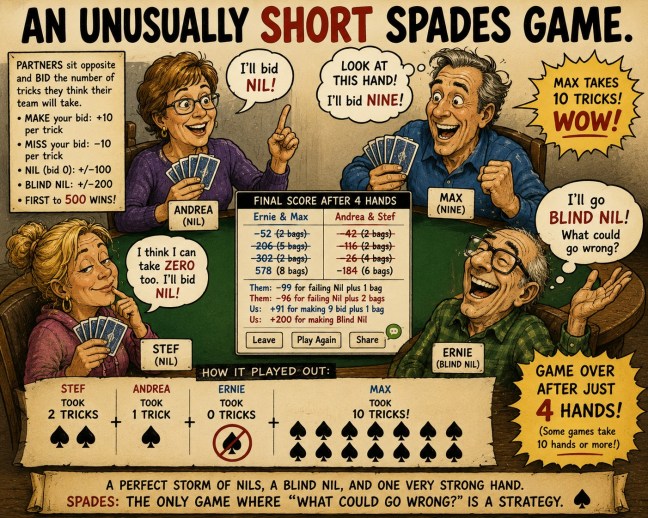
This screenshot shows the result of the fourth and last hand of an on-line Spades game. Ernie took this screenshot. Experienced Spades players need read no further; the screenshot tells it all.

In the card game Spades, partners, who sit opposite each other, bid on the number of tricks the partnership will take. The play of the cards follows Bridge rules. If they take at least that number of tricks, they get a positive score of ten times their bid. Otherwise they get a negative score of ten times their bid. Accumulated excess tricks of ten result in a 100 point deduction. Should a player bid zero (called nil) their individual score comes to plus or minus 100 points. A player bidding nil without looking at their cards (called a blind nil) gains or loses 200 points. A game ends when a team accumulates at least 500 points. As Spades players know, due to the plus or minus scoring, games can easily extend to more than ten hands.

On the last hand of this game Andrea bid first and bid nil. She hoped to take zero tricks and score 100 points for her partnership. Max happened to have a strong hand. Max bid nine hoping that his partnership would score at least 90 points. Stef saw that she, like her partner, might take zero tricks. So she bid nil. Ernie then bid nil without looking at his cards. As the expression goes: What could go wrong?

In the play Stef took two tricks, Andrea took one trick, Ernie failed to take a trick, and Max ended up with ten tricks. Wow!


Originally published in Forvm, the newsletter of Central New Jersey Mensa.

A Peeve

by Max Fine

Whatever "sacre bleu" means in French, why did PBS translate it in subtitles as "*******"? Surely we have enough strong words and idioms in American English for a translation that would fit the scene. Usually when strong language appears in a PBS TV show PBS doesn’t allow us to hear it, no sound at all, sometimes for as long as a second, and then the closed caption has "******". But I heard "sacre bleu" in an episode of Astrid. Someone decided to let me hear that.

Back in the last century PBS didn’t go as far as they do now to protect their viewers from exposure to strong language and nudity. Do you recall the first showing of I, Claudius? Too young? You missed a terrific series.

I also recall a police procedural on PBS where the police detective visited an art class and, for no reason at all, a nude model stood posing for the students. A bowl of fruit in place of the model would not have changed the story, as I recall.

I believe that nowadays people who know where to look on the internet have easy access to all sorts of content that PBS censors. Must PBS interrupt the narrative flow of a drama with periods of silence whenever a character uses strong language? Apparently the answer is: Yes. But why? PBS carefully blurs out any female nipple, even on a corpse. Don’t PBS viewers know that adult females have nipples too?

I could protect myself from exposure to nudity or strong language on TV by watching MeTV or other channels that show only old commercial TV content. Beware of TCM, some of the really old (pre-code) movies have raunchy content. And nature documentaries on whatever channel, even PBS, sometimes show reproductive behavior.

In an episode of Monk a naked woman appears on a beach. In the credits for that episode the actress appears as "naked woman" or maybe "nude woman" I don’t actually recall. But I did check the credits to see if that actress got credited for her appearance. She did. Do protect your internet savvy children from viewing that episode of Monk. Breasts! Pubic hair! Sacre bleu!


Originally published in Forvm, the newsletter of Central New Jersey Mensa.
A Peeve, Part 2

by Max Fine

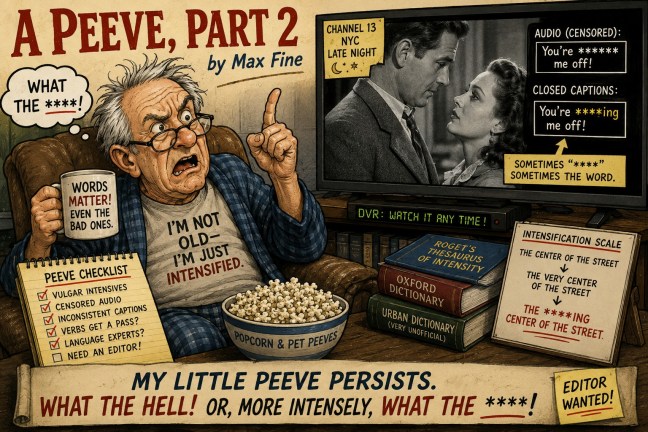
Wikipedia defines intensives thusly: Many modern-day intensives are generally considered vulgar or otherwise inappropriate in polite conversation, such as "the hell" or "the **** …". [I plucked that directly from a Wikipedia page except for replacing one word with "****".]

On March 18 Channel 13 in New York aired the movie Film Stars Don’t Die in Liverpool. The dialog in that movie contains liberal use of a certain "intensive form." The same word also appears as a verb.

In the censored audio Channel 13 replaced that certain word with silence, but not every time and, in particular, not when it came up as a verb rather than as an intensifier. In the closed captions that word appeared as "****" or sometimes as itself.

With DVR we may view anything aired on TV any time. So airing a movie with vulgar intensives late at night does not stop us from viewing them at other times.

Do language experts detect levels of intensification? Which is further from the sides: "the very center of the street" or "the ****ing center of the street"?

By the way, with reference to my peeve, Wikipedia does not censor. I have not found a G-rated version of Wikipedia.

My little peeve persists. What the hell! Or, more intensely, what the ****!

Dear readers: In the last sentences should I have used question marks instead of exclamation marks? I need an editor. ****!


Originally published in Forvm, the newsletter of Central New Jersey Mensa.
Closed Captions

by Max Fine

Some of us older folks use the closed captions feature on our TVs. It helps me especially when viewing British films. Whether the actors have English, Irish, Scottish, or Welsh accents, I sometimes need the captions to know what they’re saying.

Sometimes the captions are wrong. This can happen multiple ways. For example when the captions are taken from the script and the actors didn’t follow the script exactly.

Sometimes the captioner doesn’t hear correctly. Or maybe the actor used a word that the captioner is not familiar with.

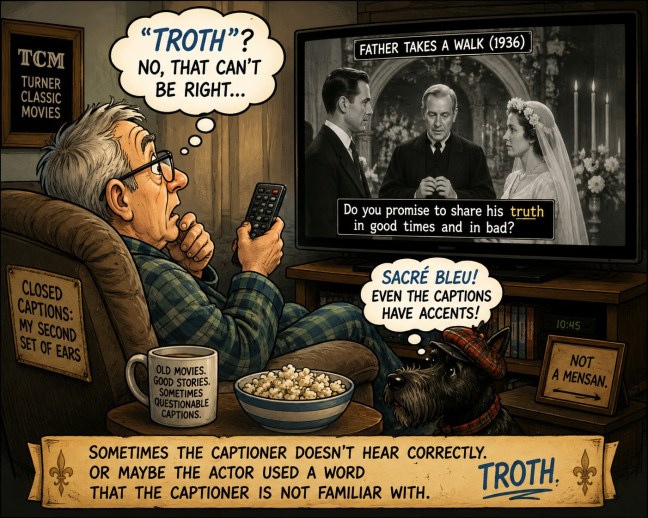
I think that’s what happened in the closing scene of a movie I just viewed, Father Takes A Walk. The captioner mistook "troth" in the wedding ceremony for "truth." Possibly not a Mensan.

I viewed that film on TCM. I recommend viewing this film even though I don’t know when it will ever become available again. TCM has a vast and growing catalog of old movies. It might be many years before they air this one again.


Originally published in Forvm, the newsletter of Central New Jersey Mensa.