by Max Fine
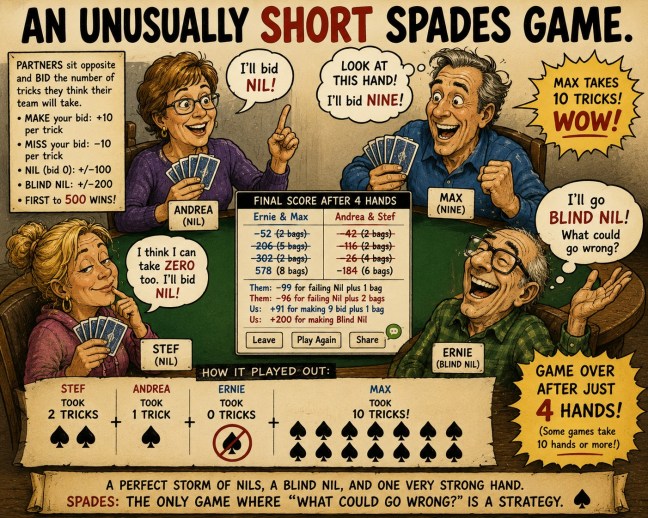
This screenshot shows the result of the fourth and last hand of an on-line Spades game. Ernie took this screenshot. Experienced Spades players need read no further; the screenshot tells it all.
In the card game Spades, partners, who sit opposite each other, bid on the number of tricks the partnership will take. The play of the cards follows Bridge rules. If they take at least that number of tricks, they get a positive score of ten times their bid. Otherwise they get a negative score of ten times their bid. Accumulated excess tricks of ten result in a 100 point deduction. Should a player bid zero (called nil) their individual score comes to plus or minus 100 points. A player bidding nil without looking at their cards (called a blind nil) gains or loses 200 points. A game ends when a team accumulates at least 500 points. As Spades players know, due to the plus or minus scoring, games can easily extend to more than ten hands.
On the last hand of this game Andrea bid first and bid nil. She hoped to take zero tricks and score 100 points for her partnership. Max happened to have a strong hand. Max bid nine hoping that his partnership would score at least 90 points. Stef saw that she, like her partner, might take zero tricks. So she bid nil. Ernie then bid nil without looking at his cards. As the expression goes: What could go wrong?
In the play Stef took two tricks, Andrea took one trick, Ernie failed to take a trick, and Max ended up with ten tricks. Wow!
Originally published in Forvm, the newsletter of Central New Jersey Mensa.
 Central New Jersey Mensa