Interesting Facts From Our Past — by John Devoti
Many nursery rhymes refer to past events, some of which, if parents knew their meanings, would never be taught to children. In the next few columns, I will talk about some of these rhymes and their origins. Remember that most of their origins are obscure, so the explanations I offer could easily be challenged, especially for the earliest examples.
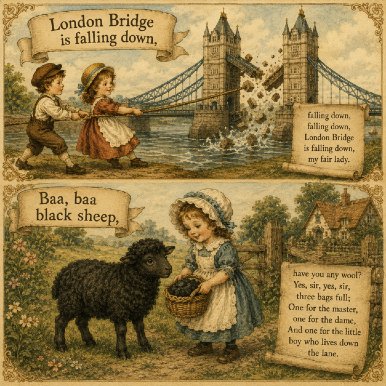
London Bridge is falling down,
Falling down, falling down.
London Bridge is falling down,
My fair lady.
This rhyme could refer to several events. As you may know, the London Bridge has actually been rebuilt several times, the first as early as 43 CE. One bridge was built around 880 during the reign of Alfred the Great. That bridge was attacked by Vikings in 1014. Although the bridge was not destroyed, it may have been severely damaged, leading to the rhyme. The best evidence for this interpretation is a similar Scandinavian rhyme that emerged in the 1200s, referring to an attack by Olaf Haraldsson.
London Bridge is broken down. —
Gold is won, and bright renown.
Shields resounding,
War-horns sounding,
Hild is shouting in the din!
Arrows singing,
Mail-coats ringing —
Odin makes our Olaf win!
The British nursery rhyme did not appear in print until the 1700s, so the rhyme could refer to any number of fires or other incidents that happened on this bridge or subsequent bridges.
Baa, baa, black sheep,
Have you any wool?
Yes, sir, yes, sir,
Three bags full.
One for my master,
One for my dame,
And one for the little boy
Who lives down the lane.
This rhyme did not appear in print until 1731, but it may refer to a wool tax imposed by King Edward I of England in 1275. After returning from the Crusades, Edward needed funds to replenish the treasury. Black sheep were highly prized and worth more because the wool required no dyeing to make dark clothing. The rhyme refers to the tax, which awarded a third to the king (master), a third to the church (dame), leaving only a third for the commoners (the little boy), hardly enough to make a living. Other versions enforce that meaning with "none for the little boy who cries down the lane."
Three hundred fifty years ago, on July 30, 1676, Nathaniel Bacon issued the "Declaration of the People of Virginia," beginning Bacon’s Rebellion against the rule of Governor William Berkeley. Bacon is usually portrayed as an early rebel against the British Crown. However, the reality is not so cut-and-dried. Although the rebellion is usually portrayed as a struggle between poor farmers and the landed aristocracy, Bacon himself was a member of that aristocracy, a cousin of Governor William Berkeley, who arrived in Virginia in 1675 with a large bankroll and a substantial land grant from the governor. In March 1676, the House of Burgesses declared war on the indigenous population, but most of the Burgesses wanted a defensive war to protect western planters, not a war to take land. Bacon saw the war differently. He asked for a commission to lead troops against the western tribes. He was denied that commission, but still assembled a band of farmers and began raiding indigenous villages. The royal government labeled him a traitor, but he was elected to the House of Burgesses by a western county.
When he arrived in Jamestown, the House would not seat him until he renounced his actions, which he did. He again asked for a commission and was denied. He then issued his "Declaration of the People" against the rich landowners, more specifically Berkeley, and was again labeled a rebel. In September, he and his followers started a fire in Jamestown, destroying much of the capital city. However, in October, Bacon died of dysentery. At that time, the king issued a royal proclamation to put down the rebellion, which lasted a few more months. Berkeley was removed as governor and recalled to England, where he died the next year.
Fifty years ago, on July 2, 1976, North Vietnam annexed South Vietnam. The United States ended American involvement in the Vietnam War with the signing of the Paris Peace Accords in January 1973. President Nixon promised to support South Vietnam in the event of new northern aggression. Despite this, North Vietnamese troops (NVA) began a new attack against the south at the end of 1973. Because of the American public’s war fatigue and the beginning of the Arab Oil Embargo, Nixon decided not to send American troops. Emboldened, the NVA started a major final offensive in 1975, occupying Saigon on April 30, effectively ending the war. A little over a year later, the North Vietnamese officially absorbed South Vietnam, forming the Socialist Republic of Vietnam, and renaming Saigon, Ho Chi Minh City.
Fifty years ago, on July 4, 1976, Israeli commandos raided a hijacked airliner at Entebbe airport in Uganda, rescuing all but four of the passengers and crew. On June 27, four Palestinian terrorists, armed with guns and hand grenades, took over the aircraft and forced Captain Michel Bacos to fly to Uganda. When they arrived, the hijackers released over 250 passengers who were not Israeli or Jewish, leaving a little over 100 passengers and crew, who were held in a terminal. Soon after the hijacking, the Israeli government, led by Prime Minister Yitzhak Rabin and Defense Minister Shimon Peres, directed military and intelligence teams to gather information and plan a rescue operation. They were aided by a Ugandan engineer who supplied plans for the airport. The plan was to approach the plane in a motorcade similar to one used by Ugandan dictator Idi Amin. The Israelis did not inform the Ugandan government of the attack and expected resistance from Ugandan forces stationed at the airport. The raid, commanded by Yonatan Netanyahu, brother of the current Israeli prime minister, was compromised when an Ugandan soldier challenged the motorcade. The resulting gunfire alerted the hijackers, and a gun battle ensued. Israeli commandos stormed the terminal, killing the hijackers and engaging Ugandan troops who responded to the attack. Three hostages were killed during the rescue operation. A fourth hostage, Dora Bloch, who had been hospitalized before the raid, was later murdered by Ugandan authorities. Between 20 and 45 Ugandan soldiers were killed, according to various accounts. The only Israeli fatality was Netanyahu. The operation was renamed Operation Yonatan in his honor.
Finally,
"Rub-a-dub-dub
Three men in a tub,
And who do you think they be?
The butcher, the baker, the candlestick maker,
And all of them out to sea."
The modern version of this nursery rhyme was first published in the late 1700s in James Hook’s A Christmas Box. However, the rhyme’s oral tradition dates back to the 1300s. When reading the latest edition, you might wonder how three craftsmen might get stuck in a tub in the middle of the sea. When you look at the original non-bowdlerized version, the meaning becomes clearer:
Hey! rub-a-dub, ho! rub-a-dub, three maids in a tub,
And who do you think were there?
The butcher, the baker, the candlestick-maker,
And all of them gone to the fair.
Today, many supermarket tabloids love to headline scandals involving Hollywood celebrities or Washington politicians. This is not new. In the Middle Ages, only aristocrats could afford tabloids, let alone read them. They would really love hearing how their local suppliers were caught at the fair in a nudie show watching three naked "maids" bathing.
About the Author
In the early 1990s, John Devoti had a midlife crisis. He did not want a motorcycle (those things are dangerous) or a new wife (his was very cute). Instead, he quit his auditing job and returned to school for his history doctorate. He wrote The Patriotic Business of Seeking Office: James K. Polk and the Patronage. It was not a bestseller. He taught college history for almost twenty years before retiring, and still dabbles by volunteering as a docent at the Roebling Museum in South Jersey. By the way, his wife and editor, Judy, is still very cute.
📖 John’s columns are collected in Tidbits of History: 25 Years of Historical Morsels — available on Amazon, Barnes & Noble, and at the Roebling Museum.

