Interesting Facts From Our Past — by John Devoti
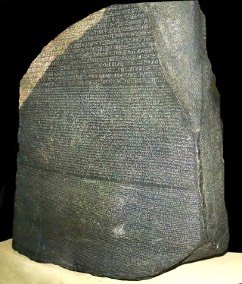
For centuries, tourists did not visit Egypt. Several of the Crusades landed at the Nile, but their main goal was the conquest of the Holy Land, not to learn lessons from the ancient lands. Interest in Egypt revived with Napoleon Bonaparte’s Egyptian campaign. Although his main goal was conquest, Bonaparte also brought a group of scientists and historians to explore the region. The second goal of his mission was much more successful, and several artifacts were returned to France. These artifacts included a large basalt slab found near Rosetta in the Nile Delta, inscribed in Hieroglyphics, Greek, and Demotic (a form of simplified Hieroglyphs). The "Rosetta Stone" remained untranslated until 1818, when French linguist Jean-François Champollion (1790-1832) compared the inscription with records from other temples. He looked at the pharaohs’ names written in hieroglyphic cartouches (rope-shaped circles containing their names). He used known pronunciations and spellings of the kings to decipher the words and explain the phonetics of the Egyptian language. For example, he saw that the first syllable of Ramses was represented by the sun disc, which gave him the word for "sun" and its pronunciation (Rah). He presented his findings in Paris in 1824, and his first book, Précis du système hiéroglyphique des anciens Égyptiens, was published that year. He finally visited Egypt in 1827 and had the chance to see the writing firsthand. He wrote notes for a grammar guide and dictionary up until his death, and the book was published posthumously by his brother.
Auguste Mariette (1821-1881) became interested in Egyptology when he inherited the papers of a cousin, Nestor L’Hôte, who had traveled with Bonaparte’s expedition and had made drawings for Champollion during his efforts to translate hieroglyphics. In 1850, he visited Egypt and began researching the Serapeum of Memphis, where he discovered the mummified remains of the Apis bulls, sacred animals kept near the temple of Apis, a creator god. After the bulls died, they were associated with the gods Sokar and Osiris, and were given full burial rites. Mariette found the tombs in disrepair and returned them, as closely as possible to their original state. Once he finished, the Serapeum became one of the major Egyptian tourist destinations.
Two hundred fifty years ago, on June 12, 1776, Virginia adopted the Declaration of Rights, an early constitution, less than a month before the Declaration of Independence. The Declaration of Rights established the framework for a state government and guaranteed several rights to citizens, including freedom of speech and religion. It also provided a section that allowed people to reform, alter, or abolish governments failing to act in the public interest. Ironically, in a colony with thousands of enslaved, there was a section stating "That all men are by nature equally free and independent and have certain inherent rights, of which, when they enter into a state of society, they cannot, by any compact, deprive or divest their posterity; namely, the enjoyment of life and liberty, with the means of acquiring and possessing property, and pursuing and obtaining happiness and safety." James Madison, a delegate to the Constitutional Convention, drew on many of those provisions in the US Constitution and later in the Bill of Rights.
Two hundred years ago, on June 22, 1826, Simón Bolívar convened the Pan-American Congress in Panama City. Beginning in 1810, many colonies in Central and South America revolted against their colonial rulers. Bolívar hoped to unite the new countries into a Latino confederation along the lines of the United States. The Congress was evenly split between those who favored Bolívar’s idea and those who preferred a group of nation-states similar to those in Europe. Unfortunately, larger states like Argentina and Brazil feared that following Bolívar’s dream would weaken them. The Congress collapsed, dooming many of the states to decades of border disputes and internal revolutions.
One hundred fifty years ago, on June 6, 1876, a group of physicians, headed by Édouard Séguin, founded the Association of Medical Officers of American Institutions for Idiotic and Feebleminded Persons. Born in France, Séguin opened a school for the developmentally challenged in Paris in 1840. During the social upheaval of 1848, he emigrated to America, first to Ohio, then to New York, and established schools in various cities. He founded the Association with the goal of training challenged youths to develop intellectual and physical skills so they could live independent lives. The Association still exists but has changed its name over the years to the American Association for the Study of the Feebleminded, the American Association on Mental Deficiency, the American Association on Mental Retardation, and, finally, the American Association on Intellectual and Developmental Disabilities in 2007.
One hundred fifty years ago, on June 17, 1876, Sioux chief Crazy Horse and General George Crook met at the Battle of the Rosebud near Rosebud Creek in Montana territory. Chiefs Crazy Horse and Sitting Bull and their followers, a mixture of Lakota Sioux, Cheyenne, and Arapaho, attacked Crook while his troops were camped by the creek. Crook’s allies, 262 Crow and Shoshone warriors, counterattacked. While their group was decimated, the scrimmage allowed Crook’s troops time to escape. A week later, on June 25, Troops under the general command of Lieutenant Colonel George Custer were not so lucky, as the three columns of his Seventh Cavalry met the same army, with two of the columns facing heavy losses, and Custer’s column was wiped out at the Battle of the Little Bighorn.
Finally, not all the great Egyptologists were men. Amelia Edwards (1831-1892) took a sightseeing trip with a friend in 1873, and they decided to visit Egypt, a trip that changed her life. Already an accomplished writer, she published A Thousand Miles up the Nile, her best-selling book. Today, tourists see the cleaned-up Egyptian monuments. Edwards saw them: the Sphinx half-buried, and the temple and tombs filled with rubble. After her return in 1874, she wrote her account and began writing reviews and articles on Egyptology. She contacted Auguste Mariette to propose using public subscriptions to support his restoration work. She founded the Egypt Exploration Fund in 1882, shortly after Mariette’s death, to continue his work. Today, the fund lives on as the Egypt Exploration Society.
About the Author
In the early 1990s, John Devoti had a midlife crisis. He did not want a motorcycle (those things are dangerous) or a new wife (his was very cute). Instead, he quit his auditing job and returned to school for his history doctorate. He wrote The Patriotic Business of Seeking Office: James K. Polk and the Patronage. It was not a bestseller. He taught college history for almost twenty years before retiring, and still dabbles by volunteering as a docent at the Roebling Museum in South Jersey. By the way, his wife and editor, Judy, is still very cute.
📖 John’s columns are collected in Tidbits of History: 25 Years of Historical Morsels — available on Amazon, Barnes & Noble, and at the Roebling Museum.
 Central New Jersey Mensa