Interesting Facts From Our Past — by John Devoti
Goosey, goosey, gander,
Where shall I wander?
Upstairs, downstairs,
And in my lady’s chamber.
There I met an old man,
Who wouldn’t say his prayers;
Take him by the left leg,
And throw him down the stairs.
Goosey, goosey, gander dates back to the English Civil War and the reign of the Lord Protector Oliver Cromwell (1653–1659). Cromwell was a Puritan and prohibited Roman Catholicism. The key to the rhyme is the second stanza, mentioning the old man. The old man was a priest who would not say his prayers in English. His use of Latin marked him as a priest who should be punished. The belief was that Catholics favored their left foot while Protestants used their right. Whether this belief was correct or not, Catholics acquired the nickname “left-footers.” So, in the rhyme, the priest was grabbed by his left foot. The execution by tossing him from a height is self-explanatory.
Rock a bye baby on the tree top,
When the wind blows, the cradle will rock,
When the bough breaks, the cradle will fall,
And down will come baby, cradle and all.
The rhyme comes from England’s Glorious Revolution of 1688. The heir to the Stuart throne was James Francis Stuart, son of James II, born in that year. Protestants who wanted reform feared the birth of the prince, believing it would lead to the continuation of the Stuart anti-Protestant laws. Many even thought Prince James was not a legitimate offspring. After ten miscarriages, they believed the prince was another stillbirth and that another child had been substituted. Opposition against James II grew (“the wind blows”). Finally, the king was overthrown and replaced by the Protestant Mary II, James’s firstborn, and her Dutch husband William III (down came the baby along with the king).
One thousand, two hundred and twenty-five years ago, on September 25, 801, the world’s oldest republic, the Most Serene Republic of San Marino, was founded by Saint Marinus. San Marino can also claim to be the world’s oldest sovereign state. After rebuilding the stone walls of Rimini on the Adriatic coast, the stonemason Marinus founded a monastic community on Mount Titan, about ten miles inland. The land was gifted to Marinus by its owner, Donna Felicissima, in recognition of his miraculous cure of her son. Although the monastic community and the later surrounding city-state were run by an elected council, there is debate about the country’s independence and democracy. The state was under the de facto protection of the Papacy until it declared independence in 1291, and the republic itself was not codified until 1600.
Two hundred and fifty years ago, on September 22, 1776, Nathan Hale was hanged for spying. As a spy, Hale was not a great success. After the American Revolution began, Hale volunteered as a first lieutenant in the Continental Army. For about six months, he saw no fighting and, in frustration, volunteered as a spy behind enemy lines. General George Washington desperately wanted to know about the British plans for Manhattan. Unfortunately, Hale arrived in Brooklyn from Connecticut two days after the British had already occupied Manhattan, rendering the mission moot. He was ordered to return to Connecticut, gathering information along the way. His questioning methods were too open, leading to his capture on September 21. His famous line, “I only regret that I have but one life to lose for my country,” was almost certainly apocryphal. The line seems to be a paraphrase from the 1713 play, Cato, by Joseph Addison: “How beautiful is death, when earned by virtue! Who would not be that youth? What pity is it that we can die but once to serve our country!” The quote attributed to Hale does not appear in the histories until the mid-nineteenth century.
One hundred and twenty-five years ago, on September 6, 1901, Leon Czolgosz shot President William McKinley at the Pan-American Exposition in Buffalo, New York. The president died eight days later. Czolgosz, the son of Polish immigrants from Detroit, had worked as a steelworker from a young age and developed a strong belief in anarchist philosophy as an adult. He justified his actions by claiming that McKinley’s assassination would help dismantle a corrupt government. Convicted of murder, Czolgosz was executed less than two months after the attack. At the time of the shooting, Vice-President Theodore Roosevelt was attending a fish and game event at Lake Champlain in Vermont. Initially reassured by doctors that McKinley was recovering, Roosevelt left for a planned excursion to climb Mount Marcy in northeastern New York. During this climb, he received the devastating news of McKinley’s death, prompting him to hurry back to take the oath of office.
One hundred and twenty-five years ago, on September 7, 1901, the Boxer Protocol officially ended the Boxer Rebellion in China. For decades, European countries had forced trade and political concessions from the weak Chinese Qing Dynasty. In early 1900, the Chinese secret society, Yihetuan (Righteous and Harmonious Fists), initiated a peasant rebellion against the foreigners. The group practiced a martial art resembling boxing, so foreign powers began calling the insurgents “Boxers.” In June 1900, the violence forced Europeans into the Legation Quarter of Peking (Beijing), and they sent out a distress call. Eight countries sent a 20,000-man force to relieve the Quarter. The force advanced quickly, but disease and heat cut their numbers in half. Despite the weakened army, a 55-day siege eventually led to the occupation of Peking. At that point, the Empress Dowager, the nominal head of the dynasty, ordered her ministers to negotiate a peace. The humiliating defeat eventually led to the dynasty’s fall ten years later.
Twenty-five years ago, on September 11, 2001, coordinated terrorist attacks by al-Qaeda killed almost 3000 people in the United States. Nineteen terrorists hijacked four airplanes and flew them into the twin towers of the World Trade Center and the Pentagon. The fourth plane, bound for the White House or Capitol, crashed in Pennsylvania after passengers wrested back control. For years, the hijackers, led by Saudi national Osama bin Laden, planned the attack. They learned to fly the jets at American flight schools, and by the time of the hijacking, most had overstayed their visas. Several members of the intelligence community warned of a possible attack, but leadership dismissed the concerns as either far-fetched or too vague to follow up. The attacks eventually led to heightened security in the United States and two wars in Afghanistan and Iraq.
Finally:
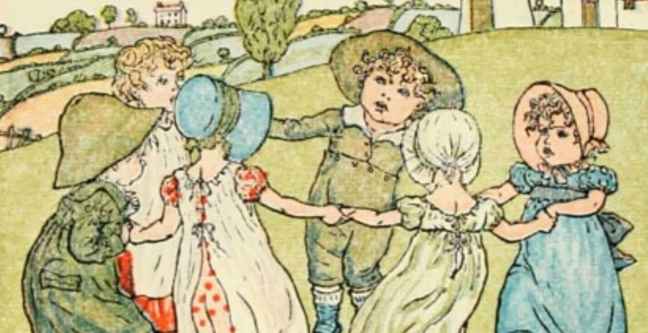
Here we go round the mulberry bush,
The mulberry bush,
The mulberry bush.
Here we go round the mulberry bush
On a cold and frosty morning.
This is the way we wash our face,
Wash our face,
Wash our face.
This is the way we wash our face
On a cold and frosty morning.
The rhyme first appeared in Nursery Rhymes of England, written by James Orchard Halliwell-Phillipps in 1842. Although similar games and rhymes are found in England, the Netherlands, and Scandinavia, this specific version refers to the women’s prison in Wakefield, England. The women’s punishment came in three stages. First, the women were separated into solitary confinement, and then forced into solitary labor. Finally, they were put in a communal facility. The rhyme refers to the prison’s exercise program. Each day, the women would be forced to dance with children around a mulberry tree in the yard. The second stanza refers to the educational program required of all women to train them to be responsible women. The tree referred to in the rhyme died in 2019.
About the Author
In the early 1990s, John Devoti had a midlife crisis. He did not want a motorcycle (those things are dangerous) or a new wife (his was very cute). Instead, he quit his auditing job and returned to school for his history doctorate. He wrote The Patriotic Business of Seeking Office: James K. Polk and the Patronage. It was not a bestseller. He taught college history for almost twenty years before retiring, and still dabbles by volunteering as a docent at the Roebling Museum in South Jersey. By the way, his wife and editor, Judy, is still very cute.
📖 John’s columns are collected in Tidbits of History: 25 Years of Historical Morsels — available on Amazon, Barnes & Noble, and at the Roebling Museum.

