Interesting Facts From Our Past — by John Devoti
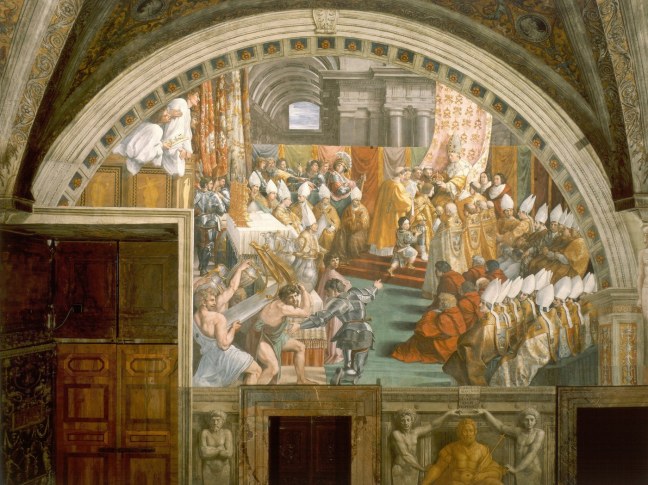
One thousand, two hundred twenty-five years ago, on December 25, 800, Pope Leo III crowned Charlemagne Holy Roman Emperor. Charlemagne became co-ruler of the Franks in 768 with his brother Carloman upon the death of their father, Pepin the Short. Charlemagne succeeded as the sole King of the Franks when Carloman died in 771. In 800, in recognition of Charlemagne’s military help in securing the papal succession, Leo granted the western lands from Northern Italy to the North Sea as far west as modern-day Spain, in what became known as the Carolingian Empire. To assist him, Charlemagne installed his son Charles the Younger as co-ruler of the Franks. When Charles died in 814, his brother Louis the Pious succeeded him. Louis succeeded his father, Charlemagne, as sole emperor after Charlemagne’s death in 814, following almost fifty years of rule.
One thousand twenty-five years ago, on December 25, 1000, Stephen I established the Christian Kingdom of Hungary. Stephen was born with the name Vajk in 975, but his parents, Grand Prince Géza and his wife, Sarolt, had him baptized with the Christian name Stephen. Stephen became the Grand Prince upon his father’s death. Although Géza was baptized, he continued to practice pagan rites throughout his life. Stephen united the Magyars under one kingdom and was crowned King of the Hungarians on August 20, 1000. Recognizing Stephen’s Christian devotion, Pope Sylvester II sent a golden crown, an apostolic cross, and a letter of blessing, recognizing him as a Christian King upon Stephen’s coronation on Christmas Day. Stephen outlived both of his children, and his nephew Peter I succeeded him in 1038. Pope Gregory VII canonized Stephen in 1083.
Two hundred fifty years ago, on December 31, 1775, British defenders defeated the American Continental Army at the Battle of Quebec, thwarting America’s first attempt to conquer Canada. Quebec became a British Canadian province in 1763 following the Seven Years’ War. Many protestant Canadians felt threatened by Quebec’s French and Catholic citizenry, and many Québécois did not appreciate their inclusion in a primarily Protestant, English colony. The American Continental Congress aimed to exploit this alienation and encourage Quebec’s inclusion in the southern colonies through conquest. The Continental Army general assigned 1,100 soldiers under Colonel Benedict Arnold to the task. By the time the small army arrived, almost half the men had died or deserted after a two-month march through the cold wilderness. A second force under General Richard Montgomery marched from Fort Ticonderoga to reinforce Arnold, but they too lost half their men. As a result, the final army included the original 1,100 number, but most of the troops were weakened by the enforced march. A severe snowstorm further hampered the American efforts, with many killed, over 400 captured, Montgomery dead, and Arnold wounded. Despite the defeat, Arnold’s army held on until British General John Burgoyne finally drove the Americans out in May 1776. In the War of 1812, the United States again tried to take Canada, but that invasion suffered a similar fate.
Two hundred twenty-five years ago, on December 24, 1800, the Rue Saint-Nicaise plot to kill Napoleon Bonaparte failed. In 1799, Bonaparte staged a coup d’état and made himself the First Consul of France, effectively ruling the country. Although most people welcomed him after years of instability, many still wanted to eliminate him. Pierre Robinault de Saint-Regent, a former army officer and leader of insurgents aiming to restore the monarchy, devised the plot. The royalists hoped that Bonaparte’s death and the resulting power vacuum would inspire a movement to restore the King. The conspirators planned to plant a bomb in a cart on Rue Saint-Nicaise and detonate it as Bonaparte’s carriage passed by on its way to the opera. Fortunately for Bonaparte, the bombers detonated the device too late, and he survived, but the street and nearby buildings suffered significant damage. While Bonaparte initially suspected that the Jacobins, radical republicans, were behind the plot, an investigation quickly uncovered the Royalist conspirators. Despite these findings, Bonaparte targeted both groups, sending both Royalists and Jacobins to the guillotine, further strengthening his control.
Seventy-five years ago, on December 25, 1950, Scottish nationalist students stole the Stone of Scone from Westminster Abbey. The origins of the sandstone block, used as a coronation seat for centuries, are unclear. It first appeared sometime in the fifth or sixth century. Many have suggested its source is Ireland, Egypt, or biblical Israel, but geologists have shown its sandstone matches that found in Scone, Scotland. The Stone was taken in 1296 by Edward I of England and brought to Westminster Abbey, where it has been used for English and British coronations. Four members of the Scottish Covenant Association, which supported self-rule through a Scottish Parliament, devised a plan to steal the Stone to promote their cause. They joined a tour of the Abbey on Christmas Eve and hid until it closed. While trying to take the Stone, they damaged the coronation chair designed to hold it and broke it in two. They transported the Stone to Glasgow. The police finally recovered it on April 10. Initially, Scottish public opinion supported the thieves, but news of British King George’s cancer diagnosis turned public opinion against the plotters, and ultimately, the Stone was returned to Westminster Abbey. Believing that prosecuting them would embarrass the monarchy, the thieves were never charged. The Coronation Chair was repaired and used in Queen Elizabeth II’s coronation. The British government officially returned the Stone to Scotland in 1996 and displayed it at Edinburgh Castle. However, the Scots return it to Westminster Abbey for coronations.
Fifty years ago, on December 2, 1975, during the Laotian Civil War, the Pathet Lao seized the Laotian capital, Vientiane, and forced the abdication of King Sisavang Vatthana, proclaiming the Lao People’s Republic. When Japan conquered Indochina (comprising Laos, Cambodia, and Vietnam), it installed King Sisavang Vong as a puppet ruler. Once the Allies retook the area, the French colonial authorities retained the King as head of state, maintaining a constitutional monarchy. In 1950, one of the King’s nephews, Prince Souphanouvong, formed the Pathet Lao (Lao Nation) to fight against the monarchy. Souphanouvong was a dedicated follower of Vietnam’s Ho Chi Minh, so America’s involvement in the Vietnam War against Ho only escalated the Laotian Civil War. Widespread antipathy to the Americans, especially after incursions in Laotian territory, brought followers to the Pathet Lao cause. The American withdrawal weakened the Laotian monarchy, which fell eight months after the fall of Saigon. Today, the Lao People’s Revolutionary Party continues to lead one of the last remaining Communist states.
Finally, twenty-five years ago, on December 12, 2000, the US Supreme Court halted the ballot recount in the presidential election in Florida in the case of Bush v. Gore. The 2000 election between Republican George W. Bush and Democrat Al Gore was very close in the Electoral College, despite Gore holding a half-million popular-vote lead. The election came down to Florida, where Bush was ahead by fewer than 2,000 votes. The close tally triggered an automatic recount. The first recount made the margin even closer at 317. On November 27, Republican Secretary of State Katherine Harris certified the election. On December 8, the mostly Democratic Florida Supreme Court ordered a third recount based on "undervotes" caused by punch-card ballots, which may have been miscounted as a result of "hanging chads," or poorly punched cards. Bush brought the case to the US Supreme Court, arguing that the state could not complete a recount before the Electoral College’s December 12 deadline. Gore’s team claimed the deadline was artificial and an accurate count was more important. The Court handed down two decisions. First, in a 7-2 vote, the Court held that Florida’s code violated equal protection laws because no specific definition of a valid punch-card vote existed. In the second decision, the Court decided in favor of Bush’s argument on the Electoral College deadline. The vote on this question was 5-4 along party lines.
About the Author
In the early 1990s, John Devoti had a midlife crisis. He did not want a motorcycle (those things are dangerous) or a new wife (his was very cute). Instead, he quit his auditing job and returned to school for his history doctorate. He wrote The Patriotic Business of Seeking Office: James K. Polk and the Patronage. It was not a bestseller. He taught college history for almost twenty years before retiring, and still dabbles by volunteering as a docent at the Roebling Museum in South Jersey. By the way, his wife and editor, Judy, is still very cute.
📖 John’s columns are collected in Tidbits of History: 25 Years of Historical Morsels — available on Amazon, Barnes & Noble, and at the Roebling Museum.

