Interesting Facts From Our Past — by John Devoti
Two hundred seventy-five years ago, on November 11, 1750, students at the College of William and Mary in Williamsburg, Virginia, formed the Flat Hat Club (FHC), the first college fraternity. The initials likely also stand for "Fraternitas, Humanitas, et Cognitio" (Brotherhood, Humanity, and Knowledge). The club was a secret, social club that, to member Thomas Jefferson, "had no useful object." Members eventually lost interest in the society, and it ended in the early 1770s. A few years later, in 1776, the Phi Beta Kappa club was formed at the College of William and Mary, the first Greek-letter fraternity.
Two hundred and fifty years ago, on November 7, 1775, John Murray, the fourth Earl of Dunmore and royal governor of the American colony of Virginia, issued the Lord Dunmore Offer of Emancipation. This proclamation promised freedom to enslaved people and indentured servants in the colony if they agreed to take up arms against American rebels. This was the first large-scale emancipation in North America. Six months earlier, Dunmore fled the Virginia capital, Williamsburg, for Norfolk because of rumors he was considering the action. With only a few hundred royal troops supporting him, Dunmore hoped he could expand his army with "Lord Dunmore’s Ethiopian Regiment," while also giving rebellious plantation owners more to think about. Soon after the proclamation, the Virginia Convention issued an offer to escaped slaves, allowing them to return to their owners within ten days without facing punishment. Between 800 and 2000 men accepted Lord Dunmore’s offer, but a smallpox outbreak reduced that number to about 300. Nonetheless, estimates suggest that at least 100,000 slaves attempted to escape during the war.
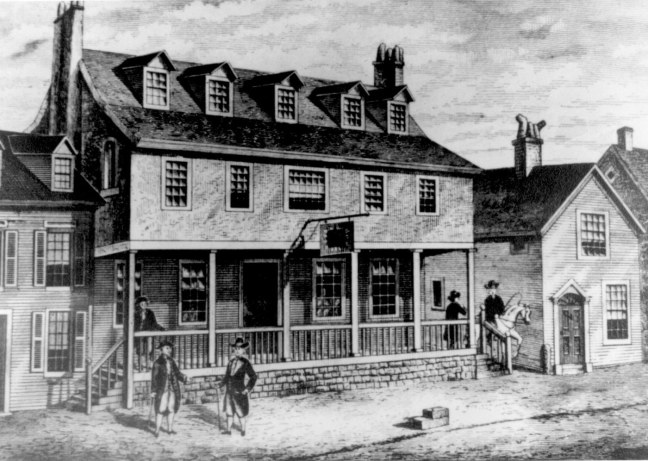
Two hundred fifty years ago, on November 10, 1775, Samuel Nicholas formed the United States Marine Corps at Tun Tavern in Philadelphia, just one of several notable events that happened at the tavern. Samuel Carpenter established Tun Tavern in 1685, just three years after the Pennsylvania colony was established. Located at the corner of Tun Alley and Water Street, the tavern had a reputation for serving the best beer in town. In 1732, the first American Freemason lodge was formed at Tun Tavern, and it would eventually become home to the Grand Lodge of Pennsylvania. Later, the St. George’s Society and the St. Andrews Society were founded to help needy Philadelphians. Benjamin Franklin formed the Pennsylvania Militia in 1756, and a congressional committee led by John Adams in October 1775 drafted a declaration of war and commissioned a naval fleet from the tavern. A month later, the Continental Congress assigned Samuel Nicholas the task of forming two battalions of marines, and he set up recruitment at the tavern.
Seventy-five years ago, on November 8, 1950, US Air Force Lt. Russell Brown shot down two North Korean MiG-15s in the first jet-to-jet dogfight. In early November, American General Douglas MacArthur authorized a bombing campaign against North Korean cities to eliminate military targets and slow the Chinese advance across the Yalu River. At the same time, Soviet-built MiG-15s joined the fight, the first time the Americans had faced the MiGs. On November 8, a group of F-80s was ordered to strafe the airfield at Sinuiju, where they met the North Korean jets. After their strafing runs, Lieutenant Russell and Major Evans Stephens were providing cover for the other fighters when Stephens spotted two MiGs, and the two pilots attacked. With only one gun still working (the others had jammed during the strafing run), Brown shot down both airplanes. The entire fight lasted less than a minute.
Finally, fifty years ago, on November 22, 1975, Juan Carlos was declared King of Spain after the death of Francisco Franco. In 1931, King Alfonso XIII fled Spain, and the Spanish Republic was proclaimed. At the end of the Spanish Civil War in 1939, Franco formed a fascist dictatorship. In 1969, recognizing he would not live forever, Franco designated Juan Carlos to succeed him as head of a constitutional monarchy. A scandal involving the king’s daughter and declining health led to his abdication in 2014. Juan Carlos was succeeded by his son, the current king Felipe VI.
About the Author
In the early 1990s, John Devoti had a midlife crisis. He did not want a motorcycle (those things are dangerous) or a new wife (his was very cute). Instead, he quit his auditing job and returned to school for his history doctorate. He wrote The Patriotic Business of Seeking Office: James K. Polk and the Patronage. It was not a bestseller. He taught college history for almost twenty years before retiring, and still dabbles by volunteering as a docent at the Roebling Museum in South Jersey. By the way, his wife and editor, Judy, is still very cute.
📖 John’s columns are collected in Tidbits of History: 25 Years of Historical Morsels — available on Amazon, Barnes & Noble, and at the Roebling Museum.

