Interesting Facts From Our Past — by John Devoti
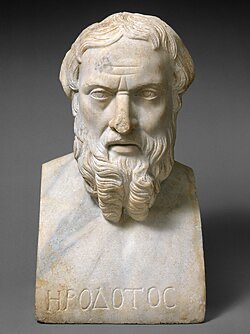
Some of you have probably done the touristy thing and visited Egypt. For others, such a visit is on the bucket list (like me). But people visiting Egypt to see the sights is not a new endeavor. Visitors have gawked at the pyramids, the temple of Karnak, or Abu Simbel. One of the earliest visitors was the Greek historian Herodotus (c. 484-c. 425 BCE). Born in Asia Minor (Modern-day Turkey), Herodotus wrote a collection of nine volumes known as The Histories, of which Volume II covers Egypt. He probably visited sometime between 450 and 430 BCE. Like most tourists, he documented his observations of the ancient monuments, but he also engaged with the locals to gain insight into their everyday lives. He marveled at the customs that differed from those in Greek culture, including the more public roles of women, their shopping in the markets, and their roles as priests, but only for female deities. While some of his claims, especially those derived from conversation, were inaccurate—such as the idea that women could only serve as priests for female gods—he accurately described various practices like mummification and the agricultural cycles tied to the annual floods of the Nile.
About four centuries later, the Sicilian Diodorus Siculus (fl. 1st century BCE) followed in Herodotus’ footsteps. Egypt appears in the first volume of Siculus’ Bibliotheca Historica, an effort to chronicle human history up to Caesar’s conquest of Gaul, which eventually reached forty volumes. While visiting Egypt around 60 BCE, Diodorus emphasized that Egyptian culture was more barbarian than Greek and Roman cultures. In his book, he commonly describes Egyptian achievements by starting with "Egyptians say" or "Egyptians claim," while rarely agreeing with them. However, he does describe the history of the Egyptians and the development of their multi-deity religion. He also discusses their agriculture, beginning as hunter-gatherers and eventually developing modern planting techniques based on the Nile River’s seasonal flooding.
Four hundred seventy-five years ago, on May 12, 1551, Charles V of Spain issued a royal decree establishing the University of San Marcos in Lima, Peru. San Marcos is the oldest university in the Americas, predating the University of Mexico by four months. In 1549, Friar Tomás de San Martín traveled to Spain to petition the king to establish a center of higher learning modeled on the University of Salamanca. Due to ill health, Friar Tomás never returned to Peru but sent Charles’ decree back to Lima. The school itself was opened in 1553 and run by Dominican monks for two decades. In 1571, King Philip II ordered the University’s secularization, and in 1574, students and professors established an independent institution. That same year, the Faculty of Law was established, and the school’s official name was changed to The Royal and Pontifical University of San Marcos of Lima. Soon, the university launched schools of the Arts, Theology, Sacred Scripture, Canon Law, and Medicine.
One hundred seventy-five years ago, on May 1, 1851, Queen Victoria opened the Great Exhibition at the Crystal Palace in London. During the 1840s, the British Society of Arts held small exhibitions of manufactured goods. Victoria’s consort, Prince Albert, became a patron of the society. He knew about larger French exhibitions and resolved to create one on an even grander scale.
In January 1850, Parliament established a Royal Commission to build a "Great Exhibition of the Works of Industry of All Nations." After rejecting many designs for the Exhibition as too expensive or impractical, the Commission settled on a glass-and-steel structure designed by Joseph Paxton, known for his designs of enormous greenhouses. To construct the Palace, Paxton chose Fox, Henderson & Company, the builders who built his earlier glasshouse designs. The final building covered 18 acres, incorporated over 3,000 columns, and used over 2,000 girders. The fair would feature works from 34 nations and would host over 14,000 exhibitors. Six million people would eventually visit the Crystal Palace before it closed in October. The exhibition made a £186,000 profit (about £20 million today) and inspired dozens of similar fairs around the world.
One hundred seventy-five years ago, on May 29, 1851, Sojourner Truth delivered her "Ain’t I a Woman?" speech at the Women’s Rights Conference in Akron, Ohio. Truth was born Isabella Baumfree in New York in 1797. She worked as a slave and in 1815, was forced to marry a fellow slave named Thomas, with whom she had five children. In 1827, New York passed the New York Anti-Slavery Law of 1827, but her owner refused to abide by it, so Truth simply left the estate. She later experienced a religious conversion and began preaching, using the name Sojourner Truth. Actually, Truth never said, "Ain’t I a woman?" The speech most quoted today was printed in 1863 and altered much of what Truth originally said. Even though she was illiterate, Truth did not speak in minstrel dialect. For example, the ending was printed in 1863 as, "If de fust woman God ever made was strong enough to turn de world upside down all her one lone, all dese togeder ought to be able to turn it back and git it right side up again, and now dey is asking to, de men better let ’em." A probably more accurate version was published in the Anti-Slavery Bugle (Salem, Massachusetts) soon after the conference. That speech ended with, "But the women are coming up, blessed be God, and a few of the men are coming up with them. But man is in a tight place, the poor slave is on him, woman is coming on him, and he is surely between a hawk and a buzzard."
Finally, Strabo (c. 64-c. 24 CE) was another ancient Egyptian tourist. He traveled to Egypt in about 27 BCE with the Roman Prefect Aelius Gallus and described his visit in Book 17 of his 17-volume work, Geography. In the book, he described the Nile and the irrigation systems that watered crops along its banks. He wrote about the customs, religious beliefs, and art of the Egyptian people. He also included commentary on the renowned monuments in Egypt, discussing whether they lived up to their reputations. He decided that the tombs in the Valley of the Kings, the boat trips at the Philae Temple complex near present-day Aswan, and the Pyramids were definitely worth the trip.
About the Author
In the early 1990s, John Devoti had a midlife crisis. He did not want a motorcycle (those things are dangerous) or a new wife (his was very cute). Instead, he quit his auditing job and returned to school for his history doctorate. He wrote The Patriotic Business of Seeking Office: James K. Polk and the Patronage. It was not a bestseller. He taught college history for almost twenty years before retiring, and still dabbles by volunteering as a docent at the Roebling Museum in South Jersey. By the way, his wife and editor, Judy, is still very cute.
📖 John’s columns are collected in Tidbits of History: 25 Years of Historical Morsels — available on Amazon, Barnes & Noble, and at the Roebling Museum.
 Central New Jersey Mensa