Interesting Facts From Our Past — by John Devoti
This month, let’s look at sayings that make little sense. For example, "as sick as a dog" suggests that dogs tend to be sicker than other animals. The expression first appears in Harvey’s Works, a collection of letters and sonnets by Gabriel Harvey. During that period, domestic dogs were generally less healthy; they were not kept as pets but were primarily working animals, not pampered by their owners. In addition, many strays roamed the cities, making them susceptible to various outdoor diseases and ailments common to denizens of cities, where sanitation was rarely adequate. Thus, the expression "sick as a dog" had genuine significance. Other phrases still used today from this period are "dog tired" or "living a dog’s life," neither of which seems relevant.
When somebody says they are feeling good, they might use the phrase "as happy as a clam." However, clams do not seem to be especially cheerful ocean creatures and likely lack the intelligence to understand happiness or sadness. This idiom has been around for quite a while. One of the earliest examples is found in James Hall’s The Harpe’s Head: A Legend of Kentucky in 1833. The phrase is more accurately "happy as a clam in high water." The point is that clams are less likely to become bird food when the high tide covers them, making them safer and, therefore, "happier."
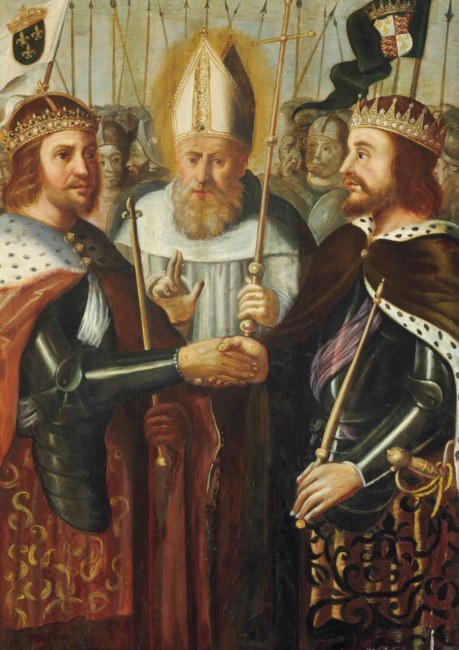
Five hundred fifty years ago, on August 29, 1475, the Treaty of Picquigny ended a brief war between France and England. The Hundred Years War (1337-1453) ended twenty years earlier, but hostility between France and England still bubbled below the surface. In 1474, English King Edward IV reached an agreement with Charles the Bold for his support of an English invasion of France. Charles reneged on the agreement once Edward landed, and France’s Louis XI easily repulsed the invasion. The two sides quickly agreed to end hostilities and agreed to a seven-year truce. Louis would supply Edward and some of his advisors a pension if England stopped bothering him. They also agreed to a marital alliance between Edward’s daughter, Elizabeth of York, and the Dauphin Charles when the couple was old enough. Edward reneged on the marriage deal, and Elizabeth eventually married England’s King Henry VII to end the War of the Roses. By then, England’s internal politics made another invasion of France unlikely.
Four hundred twenty-five years ago, on August 5, 1600, the Gowrie Conspiracy, a purported attack against King James VI of Scotland, took place. King James owed the Ruthven brothers (John, third Earl of Gowrie, and Alexander) 80,000 Scot’s pounds. The king not only wanted to have the debt canceled but also coveted the Ruthvens’ land holdings. John Ruthven was studying at the University of Padua, and, upon his return, he asked to see the king about the debt. James arrived at Gowrie House unannounced. Once he entered the house, James claimed the brothers brought him alone to a locked room and threatened to kill him. The king’s aides rescued him, killing Alexander in the process. The rest of the household was arrested and tried for treason. Gowrie and his servants were all executed except for Alexander Henderson, Gowrie’s assistant, whom many believed was James’ spy. Although James ordered his version of events circulated across the kingdom, most considered the incident a complex land grab.
Seventy-five years ago, on August 25, 1950, President Truman ordered Secretary of the Army Frank Pace to seize control of the nation’s railroads to avert a national rail strike. Truman had a history of interfering in labor negotiations. In 1946, he threatened to nationalize the railways but did not follow through. A strike began but was settled within a week. In 1950, the rail workers again threatened a strike. This time, two months after America entered the Korean War, Truman followed through on his threat and ordered the army to oversee the railroads while the two sides negotiated, using national security concerns to justify the takeover. The negotiations lasted twenty-one months, and after the settlement, the army turned control back over to the companies. In 1952, Truman tried to nationalize the steel industry for the same reasons, but the Supreme Court stopped the action, saying no federal laws permitted the president to take such measures.
Finally, the phrase "he pulled himself up by his bootstraps" is commonly used to describe a politician or businessman who has risen in their field without any outside help. However, this idea seems illogical, as the notion of pulling oneself up by the bootstraps sounds like a great way to end up falling on your butt. There is a reason the phrase appears silly—it originally meant the exact opposite of its current meaning. The Mobile, Alabama Advertiser commented on Nimrod Murphree’s claim to have invented a perpetual motion machine, writing, "Probably Mr. Murphree has succeeded in handing himself over the Cumberland river, or a barn yard fence, by the straps of his boots." Throughout the 1800s, many continued to use this description to ridicule people who made impossible claims. As late as 1927, the London Sunday Times mocked American self-improvement as "The American Bootstrapper." It is unclear when critics shifted from using the phrase for ridicule to using it as praise.
About the Author
In the early 1990s, John Devoti had a midlife crisis. He did not want a motorcycle (those things are dangerous) or a new wife (his was very cute). Instead, he quit his auditing job and returned to school for his history doctorate. He wrote The Patriotic Business of Seeking Office: James K. Polk and the Patronage. It was not a bestseller. He taught college history for almost twenty years before retiring, and still dabbles by volunteering as a docent at the Roebling Museum in South Jersey. By the way, his wife and editor, Judy, is still very cute.
📖 John’s columns are collected in Tidbits of History: 25 Years of Historical Morsels — available on Amazon, Barnes & Noble, and at the Roebling Museum.

